A beautiful mysterious cousin is suspected of murdering an Englishman’s guardian. His plotting revenge is somewhat stymied when he unwittingly falls in love with her.
Love, mystery, murder and revenge are powerful motivators and provide the central theme in this period drama based on Daphne du Maurier’s novel.
Rachel Weisz’s casting for Rachel is not surprising considering demand for complex character portrayal.
Rachel keeps us guessing as to her true nature: her black Italian mourning attire, her ambiguous expressions – is she sad or just irreverent? Is it her cultural etiquette?
Roger Michell directs a film that looks beautiful and thankfully avoids the sterile appearance of so many of similar genre. You are thrust back in time and it feels believable with authentic settings merging with the personal interplay.
Who is Rachel? Are we all too quick to judge? Her Beguiling spell is cast on the young Englishman played by Sam Claflin and as we witness his firm resolve dissolve into passion for his cousin we realise that perhaps the human condition is more layered then we imagine.
Category: Arts
Van Gogh & the Seasons
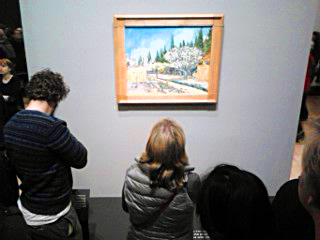
Earth yellows with saturated pinks, sinuous curving branches in crimson through to sienna. Ochre and mandarin stretch toward a distant horizon and the colours morph into a landscape of olive groves surrounding a sun drenched wheat field.
My quiet reverie is abruptly disrupted as an abnormally large group of people move to obstruct the view. But we are all excited and the throng of people disperse as quickly as they form..they seem part of an external picture that ever changes while the wheat field is forever fixed in time.
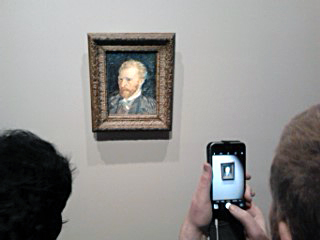
Somehow this sense of duality surrounds Van Gogh’s oeuvre. From the strongly modulated tonality of the earth tone Dutch period contrasting with the high key, chroma saturated, modernist vision of his late work; the crowded social realism of the The Potato Eaters (1885) compared with the late, nature inspired landscapes devoid of people such as Wheatfield with Crows (1890); his historical position that bridges the romantic tradition with modernist painting. And his very physicality presents a duality; the colour complimentary of his orange hair with his blue eyes.
If you manage to see the art amidst the heavy crowd invariably raises the question of the artist’s enduring popularity: how is it that he commands such following? This isn’t merely fame that is beyond the envy of today’s self obsessed society. It is of an altogether different variety reserved for the historically few. From the street to the cultural elite he is known and loved. There’s that duality again.

Printing the Future
Elizabeth Royte’s visit to 3D Systems headquarters in Rock Hill, South Carolina prompted her to ponder a philosophical quandry: just because anyone’s idea can take shape doesn’t necessarily mean that it should.
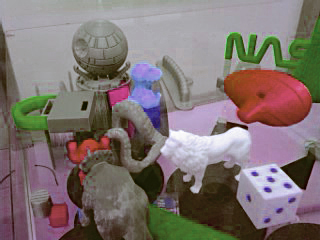
What really is the value of endless quantities of 3D objects – from miniature vases, phone cases to neon coloured skulls ? Perhaps this question has been lurking around well before the advent of 3D printing. The manufacture of endless ‘stuff’ is nothing new. Just ask your friendly archaeologist at their favourite Roman dig.
So what is 3D printing good for?
The additive process of 3D printing enables a far less wasteful process over the subtractive process of assembly line production. You can produce a single custom part for a car dashboard, key holder or child’s tricycle. You can print personalised items (including a loved one’s name for example) or design and manufacture your own innovation from concept through to final construction.
Elaborate food design is now possible. 3D printed chocolate deserts and incredible icing sugar lacework enhances wedding decorations and personalises any occasion. Contemporary cuisine combines techniques impossible just a few short years ago.
The International Space Station has had a 3D printer on board since 2014. Invariably the demand for a specific part requires a solution that is better solved on the ISS rather than waiting for the next cargo shipment – often months away.
3D printing application is ideal for Prosthetic limb construction. Instead of paying as much as $70,000 for artificial replacement that is made from moulded plastics and metals – and quite often needs replacing if fitted for a growing child – one can be printed for as little as $200. What’s more, the appearance can be personalised and now embraces (what would seem unlikely definition) the fashionable.
Printing of human tissue for body parts is now possible and recently a printed human ear fitted with a hearing device was printed at Princeton University. it consists of printed human tissue and silicone. The application for these techniques is far reaching and includes constructing new skin for cancer patients.
Stories abound in current media of unimagined applications for 3D printing: Will they print advanced weaponry from home? And what about printing yourself a TV dinner? While it may seem fanciful, these stories are not too far from reality. We are witnessing a revolution in manufacture; already we can send a digital file to a company that will print your own design in ceramic, gold or steel. See www.shapeways.com and www.sculpteo.com.
Radical technological advances in manufacture such as these have not been seen since the industrial revolution and it is not unreasonable to expect even more in the near future.
Thinking of Leonard Cohen
Portrait by Hazel FieldI first encountered Leonard Cohen in the ’80s during the music television experience and ‘I’m Your Man’ seemed to morph between melody and Cohen’s iconic face. But memory isn’t always reliable. Sometimes it tricks on recall and still the impression remains vivid.
Years later an interest in poetry led to a second and more reliable encounter. My appreciation felt like a kind of binary experience where I took to the lyrics & then the changes. Or was it the melody before the words? Anyhow, it had little to do with me but rather having been drawn toward the beguiling personality as much as the verse. His career as singer, writer and his mainstream & commercial success defy conventional wisdom as he magically redefines the role of contemporary poet. What appears as a natural, almost organic public output is surely an implausible balancing act for others and his poems’ most private thoughts seem impervious to commercial exposure. Then there’s the phenomena where songs are so celebrated they take on a life of their own and become universal standards. Hallelujah’s multi verse complexity is counter balanced with its perfectly weighted hymnal changes speaking across generations. But to me it’s the private experience that’s the thing, something like finding a guitar in the back of the cupboard with a songbook in the case – and invariably it’s Dylan or..Leonard Cohen.