Egyptian Book of the Dead

You have awaken me

Whispers by the sycamore tree

Transparent veil, remotest beckoning

You have spoken

From the path beyond

Reaching out toward infinite stars


Flung from eternity

Of the departed

You have awaken me

Whispers by the sycamore tree

The path is clearer now

You have awaken me..

What a journey I have made, the things I have seen. I am but one of you. In my hand I grasp the sailing mast, while my left hand trails in the water. The trees are heavy with figs and olives. A coconut drops to the ground. I have separated myself from myself to sail again on the green Nile waters. I sail to the temple where the gods have gathered to gaze at their faces in deep pools. In my boat the souls of the years sail with me. The hair stands on my head in the wind. I hear the splashing of oars like the cracking of a thin blue shell. Horus keeps one hand on the rudder. What a journey I have made, the things I have seen. We glide to the middle of the lake. Give me a cup of milk and cake or bread. Give me a jug of water and human flesh. Give me air to breathe and a strong sailing wind when I rise from the underworld. A sycamore rises white from the river, filling itself with water and air. Fill me with water and air. I am the blue egg of the Great Cackler and I sniff the air. I grow and live. I breathe and live. On the banks of the Nile, the sky fills with birds and the sails of boats swell like lungs.

While the above extracts differ in their expression they perhaps share similar inspiration. The first is an anonymous Western poem inspired by the Egyptian Book of the Dead while the other is an actual translation from Normandi Ellis’ translation, Giving Breath to Osiris, Phanes Press, 1991.

Egyptian civilisation had an extremely complex set of beliefs and rituals relating to the afterlife but it was the social elite that could afford the scribes to write the elaborate texts, spells & instructions to prepare their deceased. These were written on papyrus scrolls and placed in the burial chamber of the tomb.

The first modern edition (facsimile) of Egyptian funerary text was published in 1805 in Europe after Napoleon’s invasion of Egypt but it wasn’t until 1842 that Karl Richard Lepsius published a translation of a series of funerary texts of the Ptolemaic era that they were formally deciphered. The German anthropologist called them The Book of the Dead and identified a spell numbering system to decipher at least 165 different spells. The number has since increased to 192 spells relating to mystical knowledge and the protection of the deceased from unforeseen and hostile forces. They include elaborate illustrations and instructions.


judging the dead


The illustration taken from the Egyptian Book of the Dead shows the weighing of the heart of the deceased in the underworld so as to judge their worth. The heart was seen as the most important organ. (C. 1550 – 50 BC).

Interview with Robert Lloyd

My first encounter with Robert Lloyd the musician happened by chance when I stumbled upon a live performance at the Adelaide Festival Centre way back when. I was struck by the vitality and high energy music; his ensemble left a resonance with the listener hitherto unknown to me. 

Back then the term ‘World Music’ didn’t exist and he definitely pre-dated the notion. At the time the concept of a life long friendship with Robert would have seemed fanciful but it’s given me the chance to see the morphing and changes in his musical styles and approaches; he is now a writer & composer, a singer and poet.

head pic
Portrait by Vanessa Allen

Do you have a stand out memory from your childhood?

Yes, Mum and Dad dancing to Glen Miller around the lounge room

What was your earliest childhood memory?

Lynn, my sister and I sitting on our front porch waiting for our newly born brother, Peter to come home from hospital. I was 6 years

What did your parents do? How did they influence you (in any special way in life)?

Mum was a Telephonist & I learned the value of speech and communication from her. Dad was an Aquarian and did many things from a furniture salesman to a cabby. He was a very good looking guy and a gentleman. He got on well with women!

Is there a stand out moment in your life you can recall or special moment that changed your life?

I’ve had a few but perhaps when mum let me sit and watch a 11.30pm TV program called ‘The Jazz Scene U.S.A.’ to watch The John Coltrane Quartet

Is there someone who especially influenced you in any way?

Miles Davis – in every way because he kept growing and changing musically. This is what turns me on

Have you lived outside of your present city or country? What were the circumstances?

Yes, a number of places. Bali was a big influence because of Gamelan music and Paris because of Debussy, Ravel, Satie and Darius Milhaud

What is your favourite food or cuisine?

Mediterranean cuisine such as Spanish and Greek food. I like their combination of meat with salad & less grain and also the combination of food with music

Who is your favourite celebrity (past or present) & why?

Can’t think of any off hand – Yes, Charlie Chaplin

Who is your favourite musician & why?

My favourite musician is Miles Davis. He was a Gemini like me. He constantly evolved as a musician. The documentary ‘Ballad Of a Changing Man’ reveals how I musically evolved as well

Who is the person you’d most want to have a conversation over dinner with (anyone for any reason)?

Frank Lloyd Wright because of his creative genius and ability to continue designing against public opinion. Also Leonard Cohen for many musical reasons but also for fabulous conversation. He is an interface between Judaism and his song writing

If you could only take a handful of records (music) to a desert island, what would they be?

Kind of Blue, Songs of Leonard Cohen, Ravel’s Piano Concerto in G Major – especially Martha Argerich’s performance, Pet Sounds, Arvo Pärt’s Tabula Rasa

If you could bring just one or two books to a desert island, what would they be?

The Power of Now by Eckhart Tolle. There are so many books. The Old Testament. The Poetry of Dylan Thomas

What book are you reading at the moment?

The Blue Moment: Miles Davis’s Kind of Blue and the Remaking of Modern Music by Richard Williams

What is your secret vice (anything, drink type, chocolate etc)?

It’s a secret!

Favourite word or saying?

Timing is everything – mine

How do you relax or spend your time when not working?

Yoga and reading

Is there something you have done you are most proud of?

Performing ‘Feral’ in Cleveland. Also ‘Nullarbor’ at the Joyce Theater in NYC

Anything else you’d like to add?

Being true to yourself and follow your dream

https://www.facebook.com/RobertLloydComposerPoet

http://www.australianmusiccentre.com.au/artist/lloyd-robert

Treasure Island


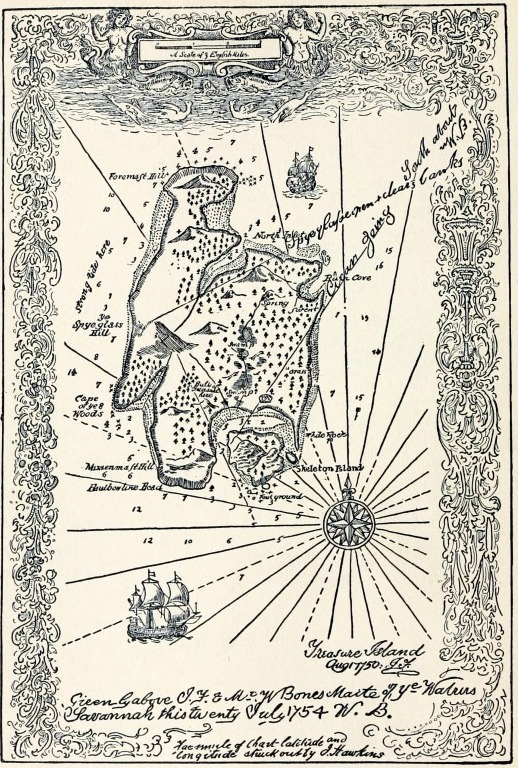
Treasure Island map
Treasure Island map

The Map

On a rainy day in August 1881, a make believe island map is created by an author with his stepson as they mark in various features and landmarks..

As they do so, the inception of an adventure story takes shape inspiring future generations of readers. Rum Cove, Spy-glass Hill, the infamous ‘X’ marks the spot (for the buried treasure of course!).

Gauging the reaction of his stepson, Robert Louis Stevenson carefully crafts a story around their fictitious island map with a cast of colourful characters including Long John Silver, Jim Hawkins, Billy Bones, and Captain Smollett among others. The pirate map is dated at 1750 and gives directions and coordinates for the secret island with its buried treasure somewhere in the Caribbean.

In retrospect the development of the novel is a tale in itself and certain events played a key role in the story’s development before final publication.

Stevenson initially serialized it in a children’s magazine called Young Folks in 1881 – 1882 titled The Sea Cook: Treasure Island or Mutiny of the Hispaniola and heres the rub – without illustrations – meaning, without the treasure map. The reason according to sources was his relative lack of recognition as an author.

The pirate story only garnered moderate interest but it was sufficient enough to republish as a single volume (as it happens, Stevenson’s intention all along). Even at this stage certain key elements of the story are missing including the final title. But ingeniously, Stevenson realizes the significance of adding illustrations – and importantly – the map with the location of the treasure. While this may appear an obvious inclusion it may not have been as evident at the time.

But as if writing himself into the script, Stevenson’s original map is lost and he is forced to recall it as best he can albeit as an altered version. It resembles an 18th century sea chart with its date of 1754 referencing all the features as we know them today (see map). The first illustrated edition of Treasure Island is published in 1884 through American publishers Roberts Brothers following an English publication without illustrations in 1883 (Cassell and company). It is a critical success bringing him fame and fortune.

William Kidd

Historically, buried pirate treasure is more myth than reality. But one such case actually exits. William Kidd is the only known pirate who is believed to have buried treasure – buried on Long Island before sailing to New York. Indeed Kidd’s story is commonly accepted as the basis for subsequent fictitious pirate tales.

Kidd’s motivation was to negotiate a conviction but he ended up hanged for the crime none the less.

Robert Louis Stevenson’s Treasure Island along with Washington Irving’s Wolfert Webber and Edger Allan Poe’s The Gold-Bug have their origins in William Kidd but also, according to Ralph D. Paine (American author), have commonality in other pirate tales. In The book of Buried Treasure he reveals a key trait where a lone surviving pirate takes possession of the treasure map and transfers it to a person on his deathbed. The map is passed to yet another (person) following thwarted attempts to locate the treasure. And so ‘Dead Man’s Chest’ serves well to dramatise and romanticise the tale of Treasure Island for example.

The remoteness of the places of burial further enhances the formula; far away islands with inaccessible features such as swamps and impenetrable jungle etc. But always a map leading back to the buried ‘loot’ for the pirates’ later retrieval. The mystery draws the reader in tracing the pirates path and motivation. Robert Louis Stevenson’s device, where ‘X’ marks the spot completes the illusion.

Pirate lies:

http://robert-louis-stevenson.org/thefirstillustrationsfortreasureisland/

https://en.wikipedia.org/wiki/Treasure_Island

Christianson, Scott 2012, 100 Diagrams that Changed the World, Salamander Books