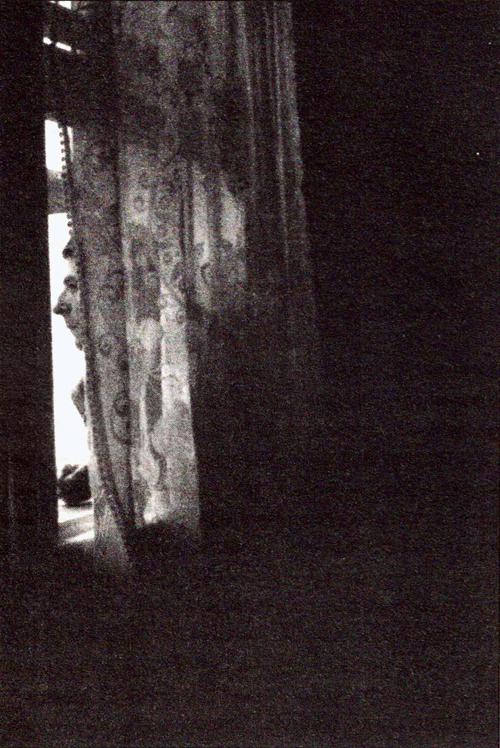
Van Gogh & the Seasons

Earth yellows with saturated pinks, sinuous curving branches in crimson through to sienna. Ochre and mandarin stretch toward a distant horizon and the colours morph into a landscape of olive groves surrounding a sun drenched wheat field.
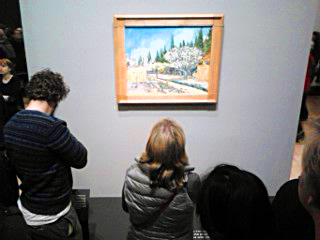
My quiet reverie is abruptly disrupted as an abnormally large group of people move to obstruct the view. But we are all excited and the throng of people disperse as quickly as they form..they seem part of an external picture that ever changes while the wheat field is forever fixed in time.
Somehow this sense of duality surrounds Van Gogh’s oeuvre. From the strongly modulated tonality of the earth tone Dutch period contrasting with the high key, chroma saturated, modernist vision of his late work; the crowded social realism of the The Potato Eaters (1885) compared with the late, nature inspired landscapes devoid of people such as Wheatfield with Crows (1890); his historical position that bridges the romantic tradition with modernist painting. And his very physicality presents a duality; the colour complimentary of his orange hair with his blue eyes.
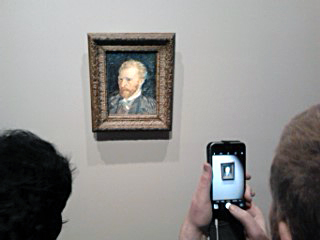
If you manage to see the art amidst the heavy crowd invariably raises the question of the artist’s enduring popularity: how is it that he commands such following? This isn’t merely fame that is beyond the envy of today’s self obsessed society. It is of an altogether different variety reserved for the historically few. From the street to the cultural elite he is known and loved. There’s that duality again.
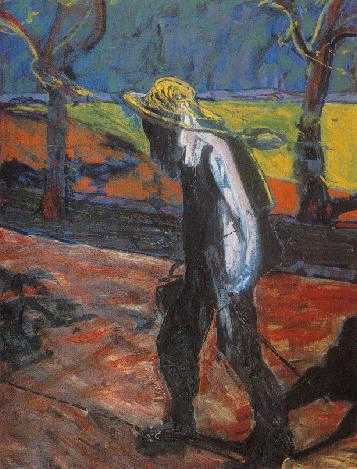

Portrait of Van Gogh by Francis Bacon

Egyptian Book of the Dead

You have awaken me

Whispers by the sycamore tree

Transparent veil, remotest beckoning

You have spoken

From the path beyond

Reaching out toward infinite stars


Flung from eternity

Of the departed

You have awaken me

Whispers by the sycamore tree

The path is clearer now

You have awaken me..

What a journey I have made, the things I have seen. I am but one of you. In my hand I grasp the sailing mast, while my left hand trails in the water. The trees are heavy with figs and olives. A coconut drops to the ground. I have separated myself from myself to sail again on the green Nile waters. I sail to the temple where the gods have gathered to gaze at their faces in deep pools. In my boat the souls of the years sail with me. The hair stands on my head in the wind. I hear the splashing of oars like the cracking of a thin blue shell. Horus keeps one hand on the rudder. What a journey I have made, the things I have seen. We glide to the middle of the lake. Give me a cup of milk and cake or bread. Give me a jug of water and human flesh. Give me air to breathe and a strong sailing wind when I rise from the underworld. A sycamore rises white from the river, filling itself with water and air. Fill me with water and air. I am the blue egg of the Great Cackler and I sniff the air. I grow and live. I breathe and live. On the banks of the Nile, the sky fills with birds and the sails of boats swell like lungs.

While the above extracts differ in their expression they perhaps share similar inspiration. The first is an anonymous Western poem inspired by the Egyptian Book of the Dead while the other is an actual translation from Normandi Ellis’ translation, Giving Breath to Osiris, Phanes Press, 1991.

Egyptian civilisation had an extremely complex set of beliefs and rituals relating to the afterlife but it was the social elite that could afford the scribes to write the elaborate texts, spells & instructions to prepare their deceased. These were written on papyrus scrolls and placed in the burial chamber of the tomb.

The first modern edition (facsimile) of Egyptian funerary text was published in 1805 in Europe after Napoleon’s invasion of Egypt but it wasn’t until 1842 that Karl Richard Lepsius published a translation of a series of funerary texts of the Ptolemaic era that they were formally deciphered. The German anthropologist called them The Book of the Dead and identified a spell numbering system to decipher at least 165 different spells. The number has since increased to 192 spells relating to mystical knowledge and the protection of the deceased from unforeseen and hostile forces. They include elaborate illustrations and instructions.


judging the dead


The illustration taken from the Egyptian Book of the Dead shows the weighing of the heart of the deceased in the underworld so as to judge their worth. The heart was seen as the most important organ. (C. 1550 – 50 BC).

Thinking of Leonard Cohen


by Hazel FieldPortrait by Hazel Field

I first encountered Leonard Cohen in the ’80s during the music television experience and ‘I’m Your Man’ seemed to morph between melody and Cohen’s iconic face. But memory isn’t always reliable. Sometimes it tricks on recall and still the impression remains vivid. 

Years later an interest in poetry led to a second and more reliable encounter. My appreciation felt like a kind of binary experience where I took to the lyrics & then the changes. Or was it the melody before the words? Anyhow, it had little to do with me but rather having been drawn toward the beguiling personality as much as the verse. His career as singer, writer and his mainstream & commercial success defy conventional wisdom as he magically redefines the role of contemporary poet. What appears as a natural, almost organic public output is surely an implausible balancing act for others and his poems’ most private thoughts seem impervious to commercial exposure. Then there’s the phenomena where songs are so celebrated they take on a life of their own and become universal standards. Hallelujah’s multi verse complexity is counter balanced with its perfectly weighted hymnal changes speaking across generations. But to me it’s the private experience that’s the thing, something like finding a guitar in the back of the cupboard with a songbook in the case – and invariably it’s Dylan or..Leonard Cohen.