Treasure Island


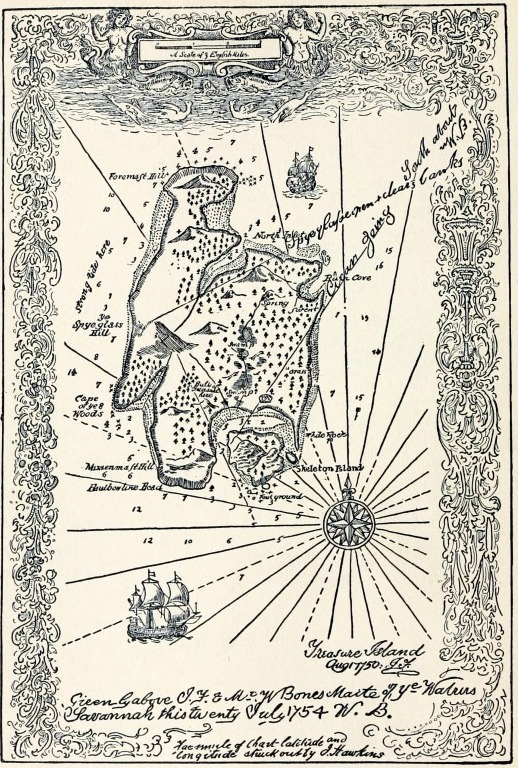
Treasure Island map
Treasure Island map

The Map

On a rainy day in August 1881, a make believe island map is created by an author with his stepson as they mark in various features and landmarks..

As they do so, the inception of an adventure story takes shape inspiring future generations of readers. Rum Cove, Spy-glass Hill, the infamous ‘X’ marks the spot (for the buried treasure of course!).

Gauging the reaction of his stepson, Robert Louis Stevenson carefully crafts a story around their fictitious island map with a cast of colourful characters including Long John Silver, Jim Hawkins, Billy Bones, and Captain Smollett among others. The pirate map is dated at 1750 and gives directions and coordinates for the secret island with its buried treasure somewhere in the Caribbean.

In retrospect the development of the novel is a tale in itself and certain events played a key role in the story’s development before final publication.

Stevenson initially serialized it in a children’s magazine called Young Folks in 1881 – 1882 titled The Sea Cook: Treasure Island or Mutiny of the Hispaniola and heres the rub – without illustrations – meaning, without the treasure map. The reason according to sources was his relative lack of recognition as an author.

The pirate story only garnered moderate interest but it was sufficient enough to republish as a single volume (as it happens, Stevenson’s intention all along). Even at this stage certain key elements of the story are missing including the final title. But ingeniously, Stevenson realizes the significance of adding illustrations – and importantly – the map with the location of the treasure. While this may appear an obvious inclusion it may not have been as evident at the time.

But as if writing himself into the script, Stevenson’s original map is lost and he is forced to recall it as best he can albeit as an altered version. It resembles an 18th century sea chart with its date of 1754 referencing all the features as we know them today (see map). The first illustrated edition of Treasure Island is published in 1884 through American publishers Roberts Brothers following an English publication without illustrations in 1883 (Cassell and company). It is a critical success bringing him fame and fortune.

William Kidd

Historically, buried pirate treasure is more myth than reality. But one such case actually exits. William Kidd is the only known pirate who is believed to have buried treasure – buried on Long Island before sailing to New York. Indeed Kidd’s story is commonly accepted as the basis for subsequent fictitious pirate tales.

Kidd’s motivation was to negotiate a conviction but he ended up hanged for the crime none the less.

Robert Louis Stevenson’s Treasure Island along with Washington Irving’s Wolfert Webber and Edger Allan Poe’s The Gold-Bug have their origins in William Kidd but also, according to Ralph D. Paine (American author), have commonality in other pirate tales. In The book of Buried Treasure he reveals a key trait where a lone surviving pirate takes possession of the treasure map and transfers it to a person on his deathbed. The map is passed to yet another (person) following thwarted attempts to locate the treasure. And so ‘Dead Man’s Chest’ serves well to dramatise and romanticise the tale of Treasure Island for example.

The remoteness of the places of burial further enhances the formula; far away islands with inaccessible features such as swamps and impenetrable jungle etc. But always a map leading back to the buried ‘loot’ for the pirates’ later retrieval. The mystery draws the reader in tracing the pirates path and motivation. Robert Louis Stevenson’s device, where ‘X’ marks the spot completes the illusion.

Pirate lies:

http://robert-louis-stevenson.org/thefirstillustrationsfortreasureisland/

https://en.wikipedia.org/wiki/Treasure_Island

Christianson, Scott 2012, 100 Diagrams that Changed the World, Salamander Books

Meditation and A Bird Crossing the Sky

Today we have such a plethora of choices in non-western medicine it seems overwhelming: Theta, Reiki Spiritual Healing, Distance Reiki Healing, Chaka balancing, Crystal Healing, Aura Cleaning, Ascended Clairvoyance and Tarot, Wellbeing through Moon Tuning Astrology, Psychic Readings, Pineal/3rd Eye Activation, Quantum Bioenergetics Emotional Freedom Techniques, Quantum Touch Healing, Spectra Healing –  have I missed any?

No less exhausting is the choice of meditation practices: Open Monitoring Meditation, Effortless Presence & Focussed Attention Meditation. From Buddhism there is Metti, Sati, Vipassana & Zazen Mediation. Of Hindu there is Self Enquiry or Alma Vichara Meditation, Transcendental Meditation, Om Meditation & Yoga Meditation. Of Chinese there Qigong and Taoist Meditation. There is Christian Meditation, Binaural Beats Meditation and Guided Meditation.

In case you’ve forgotten Yoga, some groups to choose in your spare time are Anusara, Ashtana, Bikran, Hatha, Lyengar, Jivamukti, Kripalu, Kindalini, Restorative, Sivanand, Vini Yoga, Vinyasa/Power and Yin Yoga. Oh, and don’t forget Laughter Yoga..

To what extent do these practices include meditation? And although we acknowledge the profound healing properties of meditation a simple definition may prove to be more allusive than imagined. An exercise in the philosophically allusive could be as follows: Mindfulness is associated with meditation perhaps by way of explanation but how can this be when the very act of meditating is to free oneself of the mind or to enter a thoughtless state? Surely an awareness of thoughtlessness is to be mindful.. Oh dear, I don’t think I am any closer.

Fortunately there is a better definition and one that gives us greater understanding. Kim Zetta in her essay entitled ‘Keep taking The Meditation’ defines it as ‘a method of mental training that involves focussed attention for the purpose of spiritual development or self actualisation’

Is it possible to fathom the fascinating and equally allusive process of meditation by way of science? Doctor Richard Davidson’s research at The University of Wisconsin surely demonstrates this. What follows is testament not only to the interconnectedness of science & mind but also evidence to the lasting health benefits of meditation.

A Buddhist monk called Öser underwent Functional Magnetic Resonance Imaging (or fMRI) testing in order to discover the mysterious workings of the mind during meditation. As a trained Molecular Biologist (Institut Pasteur in Paris), Öser patiently alternated between meditation and rest while his brain’s activity was recorded.

And in the process Doctor Richard Davidson and his team of scientists at the Laboratory for Affective Neuroscience discovered a phenomena whereby the practice of meditation can effectively ‘rewire’ the human brain for health and happiness. They measured activity in Öser’s left prefrontal cortex, the part most associated with feelings of happiness & joy and observed cerebral activity to be off the chart even when at rest between his focussed meditation.

According to Davidson, extensive research suggests that meditating strengthens parts of the brain that reduce fear and anger so bringing about happiness & general well being. It seems to have a cumulative effect over time reducing the depth of negative emotions. Meditation appears to generate an individual’s overall positive state so becoming their emotional default, as it were.

Part of Öser’s test included the unexpected firing of a gun and although a slight increase in heart rate and blood pressure were recorded during meditation he seemed hardly to react. Other subjects taking the test could not suppress their reaction to this unexpected shocking disturbance. In Öser’s words it seemed as uneventful as ‘a bird crossing the sky’.

Taoist meditation in "The Secret of the Golden Flower"
Taoist meditation in “The Secret of the Golden Flower”

InnerSelf Sept-Nov 2015

innerself.com.au

Types of Meditation- An Overview of 23 Meditation Techniques

liveanddare.com

Keep Taking the Meditation 

http://www.mindbodysolutions.com.au/newsletters/keepingtakingthemeditation.pdf

Richard Davidson

https://en.wikipedia.org/wiki/Richard_Davidson