leaked drawings


leaked drawings
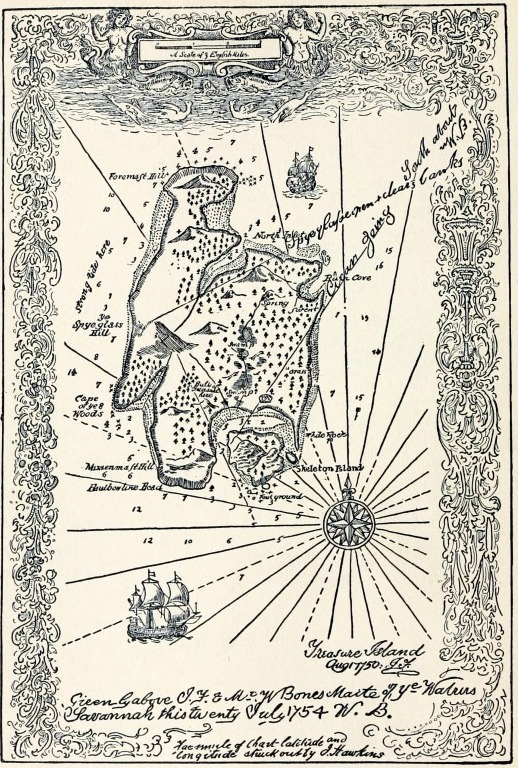
The Map
On a rainy day in August 1881, a make believe island map is created by an author with his stepson as they mark in various features and landmarks..
As they do so, the inception of an adventure story takes shape inspiring future generations of readers. Rum Cove, Spy-glass Hill, the infamous ‘X’ marks the spot (for the buried treasure of course!).
Gauging the reaction of his stepson, Robert Louis Stevenson carefully crafts a story around their fictitious island map with a cast of colourful characters including Long John Silver, Jim Hawkins, Billy Bones, and Captain Smollett among others. The pirate map is dated at 1750 and gives directions and coordinates for the secret island with its buried treasure somewhere in the Caribbean.
In retrospect the development of the novel is a tale in itself and certain events played a key role in the story’s development before final publication.
Stevenson initially serialized it in a children’s magazine called Young Folks in 1881 – 1882 titled The Sea Cook: Treasure Island or Mutiny of the Hispaniola and heres the rub – without illustrations – meaning, without the treasure map. The reason according to sources was his relative lack of recognition as an author.
The pirate story only garnered moderate interest but it was sufficient enough to republish as a single volume (as it happens, Stevenson’s intention all along). Even at this stage certain key elements of the story are missing including the final title. But ingeniously, Stevenson realizes the significance of adding illustrations – and importantly – the map with the location of the treasure. While this may appear an obvious inclusion it may not have been as evident at the time.
But as if writing himself into the script, Stevenson’s original map is lost and he is forced to recall it as best he can albeit as an altered version. It resembles an 18th century sea chart with its date of 1754 referencing all the features as we know them today (see map). The first illustrated edition of Treasure Island is published in 1884 through American publishers Roberts Brothers following an English publication without illustrations in 1883 (Cassell and company). It is a critical success bringing him fame and fortune.
William Kidd
Historically, buried pirate treasure is more myth than reality. But one such case actually exits. William Kidd is the only known pirate who is believed to have buried treasure – buried on Long Island before sailing to New York. Indeed Kidd’s story is commonly accepted as the basis for subsequent fictitious pirate tales.
Kidd’s motivation was to negotiate a conviction but he ended up hanged for the crime none the less.
Robert Louis Stevenson’s Treasure Island along with Washington Irving’s Wolfert Webber and Edger Allan Poe’s The Gold-Bug have their origins in William Kidd but also, according to Ralph D. Paine (American author), have commonality in other pirate tales. In The book of Buried Treasure he reveals a key trait where a lone surviving pirate takes possession of the treasure map and transfers it to a person on his deathbed. The map is passed to yet another (person) following thwarted attempts to locate the treasure. And so ‘Dead Man’s Chest’ serves well to dramatise and romanticise the tale of Treasure Island for example.
The remoteness of the places of burial further enhances the formula; far away islands with inaccessible features such as swamps and impenetrable jungle etc. But always a map leading back to the buried ‘loot’ for the pirates’ later retrieval. The mystery draws the reader in tracing the pirates path and motivation. Robert Louis Stevenson’s device, where ‘X’ marks the spot completes the illusion.
Pirate lies:
http://robert-louis-stevenson.org/thefirstillustrationsfortreasureisland/
https://en.wikipedia.org/wiki/Treasure_Island
Christianson, Scott 2012, 100 Diagrams that Changed the World, Salamander Books

‘A yogi levitates at the Conway Hall’, ‘Golfer is knocked out by his own back-swing’, ‘Tarantulas employed to guard jewellery’.. and the stories keep coming because there seems to be an unlimited appetite for the strangest, weirdest and sensational.
And why not? ‘A cheating husband reveals lover’s details in sleep’ would be a nightmare right? ’A shop assistant loses $2,700 by misreading price tag’ is ideal for a resume. Who knows, ‘Portrait of a politician sculpted in poo’ may actually be an act of flattery and perhaps ‘A forger’s spelling error’ was a freudian slip (yeah, right).
Observe the seemingly limitless updates in the weird and bizarre categories on sites such as Daily Bhaskar http://daily.bhaskar.com/bizarre/1 & Daily Picks and Flicks http://dailypicksandflicks.com/category/weird-3/strange-news/ And you weren’t tempted to read beyond the headlines?
Rude tube https://www.youtube.com/user/RudeTubers & Vidmax.com http://vidmax.com/wtf-videos may satisfy a limited demographic but the benign and ridiculous seem to regularly appear at the end of prime-time, free-to-air news bulletins.
But as is often the case & on closer inspection the formula for this type of news may not be so obvious. Real macabre and horror (of the homicide variety) are avoided so that the serious is bypassed for the trivia and funny lending to the full spectrum of human emotions. The scary of the spook variety is supplanted with the slap-stick spook; its not so much ‘The ghosts at Huddon-le-Green’ but rather ‘Girl sees religious message in tomato’ or ‘Man lets honeybees form enormous beard on his chin’. Things can be funny peculiar and not just plain scary or as so many commentators say of our 24/7 news cycle, ‘exhaustive and unrelenting’.
What is surprising is the sheer number of weird and ridiculous stories so much so it may seem impossible to replenish and to satisfy an equally insatiable appetite for them. And they seem to match the text message- micro blogging society we have become. Explanation equals title equals news grab;’Fresh air for sale’, ‘Russian politician attacked with cake and Bus stop stomper’.
But records show the scammers and swindlers have been making news for some time. It’s nothing new. All you need is the incitement and the opportunity and suddenly there’s no end to the associated crimes. Pennsylvania is home to one of the longest door-to-door scams since the 1930’s. A group of scammers some 5000 strong of the Williamson clan carry out dodgy house repairs. When the bad weather comes the house paint runs and the freshly laid asphalt repairs conveniently wash away. Of course during the period of the swindle the Williamson’s children are placed in public schools. And then its on to the next rip-off. Today’s headline could read something like ‘Repair racket swindle’.
Tokyo is home to a well practiced con since the 1960’s. Pedestrians conveniently bump into an unsuspecting car and while they’re writhing on the ground hostile crowds gather blaming the innocent driver. Perhaps ’Set-up pedestrian accident’ would be today’s sound grab.
So if you’re in the mood for the crazy and colourful there’s an endless supply. Weird News http://metro.co.uk/news/weird/ & But First http://www.abc.net.au/newsradio/programs/butfirst/ are especially noteworthy for the real and seemingly nonsensical.

Weird sources:
James Morton and Hilary Bateson, Conned: Scams, Frauds and Swindles
Tim Healy, Strange But True
Geoff Tibballs, The Mammoth Book of Weird News
Dziemianowicz, Weinberg & Greenberg, 50 Ghost Stories
 scribblesdotbiz